This blog was originally published in the Fall 2025 issue of The Northern Light. Written by Roger VanGorden, 33º, Active for Indiana.
This essay follows the themes in “Freemasonry as the Third Place,” which appeared in the previous issue of The Northern Light. That article explored how Freemasonry uniquely fulfills sociologist Ray Oldenburg’s concept of the “third place,” a neutral ground for meaningful connection beyond home and work. If that is the case, the next question is: What role can such a place play in America’s civic future?
As noted previously, the theme song from Cheers captured something lasting: “Making your way in the world today takes everything you’ve got. Taking a break from all your worries sure would help a lot.”
This is sociology, not merely quaint lyrics. And they speak to the very need Freemasonry is equipped to meet.
The Decline of Civic Engagement and Social Trust in America
In his book The Upswing, political scientist Robert Putnam traces a broad arc in American history. Putnam demonstrates a movement from individualism toward community in the early 20th century, followed by a retreat to individualism after the 1960s. Remember the “Me Generation?” Civic engagement, social trust, and community involvement rose together. Then, they fell together. Fraternal organizations, civic clubs, and churches all mirrored this trajectory. So did Freemasonry.
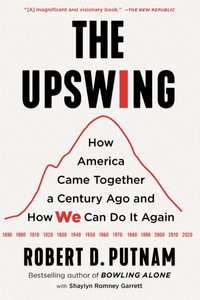 In his books, The Upswing, and Bowling Alone, Robert Putnam explores the rise and fall of community in America.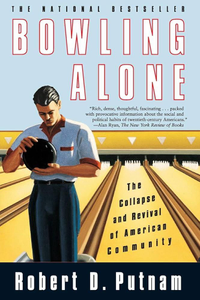
Putnam’s earlier work, Bowling Alone, captured this collapse of social capital. Fewer people joined clubs starting in the 1960s. Neighbors didn’t know each other. Participation shrank. What was lost wasn’t just membership rolls. What was lost was meaning. What was lost were those small, regular human moments that add up to community. One example Putnam noted is that while bowling participation stayed relatively stable, the number of leagues plummeted. We were still bowling. We were just bowling alone. Freemasonry was one of those displaced sources of connection.
In The Upswing, Putnam is sharper. He argues that the 1960s replaced the cooperative “we” with a culture of “unfettered self-interest,” an ethic that frayed the bonds of communal trust. But this shift wasn’t inevitable. And it’s not irreversible. As he reminds us, “the pendulum can swing back.” History shows we’ve done it before.
The Growing Crisis of Male Disconnection in America
There is further proof. Recent studies show that men are feeling increasingly disconnected. A Stanford study found that one in five men reports having no close friends. Among younger men, it’s worse. Gallup reports that one in four men under 35 struggles with frequent loneliness. While social media promised connection, both active and passive use have been linked to isolation. The digital world often replaces connection with distraction, scrolling instead of conversation. Men scrolling through the noise, looking for something that feels real. This is the disconnection Putnam warned about.
This cultural unraveling isn’t something abstract. It touches daily life, our friendships, our neighborhoods, and our capacity to build anything lasting. If the third place is disappearing, and social trust is unraveling, then the question becomes urgent. What institutions are left that still form character, cultivate community, and teach men how to belong? Where do men still go to be known, challenged, and changed?
How Freemasonry Helps Combat Social Isolation and Male Loneliness
Enter Freemasonry. It offers a radically different path: intentional, face-to-face fellowship.
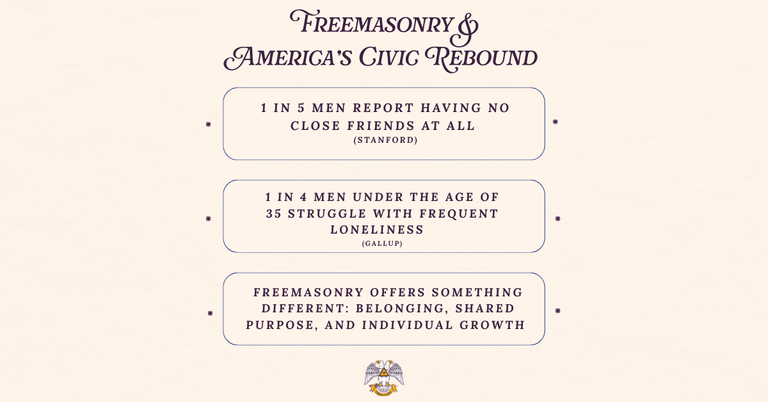 In a time of rising loneliness, Freemasonry offers belonging, shared purpose, and meaningful connection.
Freemasonry isn’t a social club. It’s a social movement. One of the last, perhaps only, institutions where men are shaped not for show but for substance. And that shaping happens in person, with presence, through practice. This brings us back to Oldenburg and the third place. Freemasonry doesn’t merely align with Oldenburg’s third place; it may be the clearest surviving example. A space where men gather not for transaction, but transformation. Where the teachings, values, and shared experience bind men together.
Where presence matters more than performance.
Why Ritual and Presence Matter in Building Brotherhood
Some complain that too much time is spent on ritual. But ritual is not a barrier. It’s a bridge. It connects the individual to the collective, the present to the past. It gives shape to identity and clarity to purpose. Freemasonry does not resist modernity out of stubbornness. It offers something modernity forgot how to value: the making of a man.
“Recent studies show that men are feeling increasingly disconnected.”
Other modern third places, such as gyms, sports leagues, and youth athletics offer camaraderie, but often without continuity. You play a season. Then you move on. Parents watch from the sidelines. Relationships stay casual. Freemasonry offers something deeper. It’s not entertainment. It’s investment.
Freemasonry as a Civic Tool, Not Just a Fraternity
We already know what Freemasonry is. We say that by improving the character of the individual, Freemasonry improves the community. But we often overlook what it could become. Freemasonry is not only a third place. It is a civic tool. A cultural resource. A ready-made response to disconnection.
The path forward lies not in new policies. It lies in renewed presence, purpose, and practice. If we believe Freemasonry shapes better men, then we must believe those men shape better communities. It begins within the Fraternity. But it must move outward.
Freemasonry is not a relic of the past. It is a remedy for the future. And if the upswing is coming, we don’t need to chase it. We need to open the door, set the working tools in place, and welcome it in.
How Does Freemasonry Still Strengthen Civic Leadership Today?
Skeptics may ask: If that’s true, where’s the proof? The answer isn’t always in headlines. It’s in habit. Freemasonry quietly shapes civic leaders, teachers, volunteers, and mentors whose steady hands are formed by its teachings.
This isn’t a new mission. It’s a rediscovery of what was always there. Generations before us understood the civic impact of Freemasonry. Think for a moment about the Brothers whose names still hang on your lodge’s wall or the ones who helped shape your Valley’s place in the community. They lived it. Now it’s our turn. Rediscovery means more than remembering. It means doing.
Why Freemasonry Matters in America’s Civic Rebound
Consider this: Freemasons don’t get together to have meetings. We have meetings to get together.
Because sometimes, a man needs a place where everybody knows his name and reminds him who he’s meant to be.